Google’s First AI Search Optimization Guide: What It Means for Your Website in 2026
 connect@gap3.co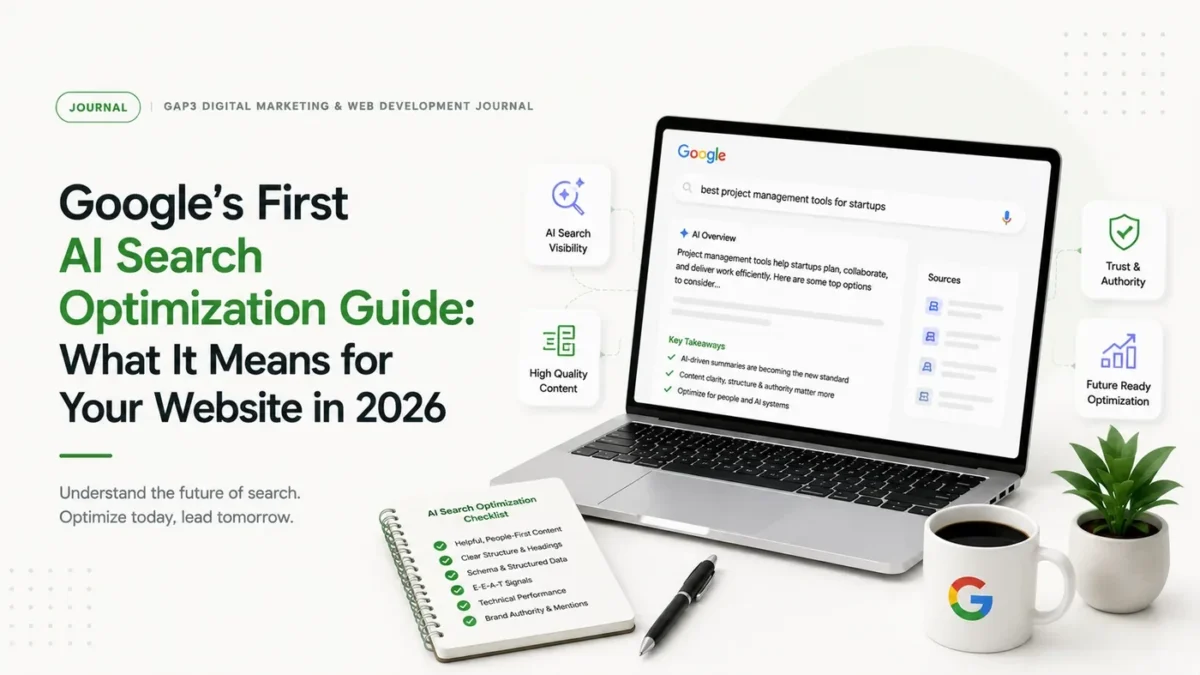
The headline: AI search is still SEO
For two years, the SEO industry has argued about acronyms. AEO, GEO, LLMO, AIO, a steady stream of AI search optimization frameworks, each promising a new playbook for a world where AI answers the question before anyone clicks. On May 15, 2026, Google finally weighed in directly, publishing its first official guide to optimizing for generative AI features in Search.
If you take one thing from Google’s guide, take this. Google’s position is unambiguous: optimizing for generative AI search is optimizing for the search experience, and thus still SEO. There is no separate AI index and no separate AI playbook. AI Overviews and AI Mode are built directly on top of Google’s existing core Search ranking and quality systems.
This matters because much of the industry has been selling the opposite story, that AI search demands an entirely new discipline with new files, new formats, and new tactics. Google reframes AEO and GEO not as separate fields but as part of SEO done well. An industry study found that the overwhelming majority of links appearing in AI Overviews come from pages already ranking in the top organic results. There is no shortcut from outside the index into AI visibility.
How Google’s AI search actually works
The guide explains two mechanisms every site owner should understand.
Retrieval augmented generation, also called grounding, is how Google keeps AI answers accurate and fresh. Rather than answering from a model’s memory alone, the system uses core Search ranking to retrieve relevant, up to date pages from the index, reviews the specific information in them, and generates a response with prominent, clickable links back to the supporting pages. If your page is not indexed and eligible to rank, it cannot be retrieved, and it cannot be cited.
Query fan out is the second mechanism. When someone asks a question, Google generates a set of related sub queries to gather a fuller picture. Your page can appear in an AI answer for queries you never explicitly targeted, as long as your content covers the topic with genuine depth. Both mechanisms point to the same conclusion: depth, accessibility, and quality win. Narrow, exact match keyword pages do not.
What Google says actually matters
1. Create valuable, non commodity content
Google calls this the single biggest long term factor for visibility in generative AI search, more important than any technical tweak. Commodity content restates common knowledge that anyone, or any AI model, could produce. Non commodity content brings genuine expertise and experience. The difference is original insight. A first hand review, real case study, or expert analysis offers something a model cannot generate on its own. Google’s simplifying question is worth pinning to your wall: is this content that my visitors would find satisfying?
2. Build and maintain a clear technical structure
- Be eligible. To appear in AI Overviews or AI Mode, a page must be indexed and eligible to show in Search with a snippet.
- Be crawlable. Google’s AI models rely on publicly accessible, crawlable content. Blocked pages are invisible.
- Use semantic HTML. Proper structure helps every reader, including screen readers and AI parsers.
- Follow JavaScript SEO best practices. Framework heavy sites need extra care so content is not hidden behind un rendered scripts.
- Provide good page experience. Fast, mobile friendly pages with a clear separation between main content and everything else.
- Reduce duplicate content so crawl budget is not wasted on URLs that do not matter.
3. Optimize local and ecommerce details
Where relevant, AI responses surface product listings and local business information. Google recommends keeping your Google Business Profile accurate and using structured product feeds through Merchant Center.
4. Add high quality images and video
AI search results increasingly include visual content, which means more surface area for your brand beyond plain links. Support your written content with relevant, original images and video, and follow standard image and video SEO practices.
The mythbusting section: what you can stop doing
This is arguably the most useful part of the guide, an explicit list of popular AI search tactics that Google says are unnecessary.
- llms.txt files and special AI markup. You do not need machine readable files, AI text files, AI specific markup, or Markdown versions of pages.
- Chunking content. There is no requirement to break articles into tiny AI digestible pieces. There is no ideal page length.
- Rewriting content for AI. AI systems understand synonyms and intent. You do not need to capture every long tail variation.
- Chasing inauthentic mentions. Manufacturing brand mentions across low quality sites is not the shortcut it appears to be.
- Over focusing on structured data. Schema is not required for AI search. Keep using it for rich result eligibility in traditional Search.
- Mass producing pages for every query variation. This violates Google’s scaled content abuse policy and does not work.
Spam policies now cover AI answers
Alongside the guide, Google made a quieter but important change: Search spam policies now explicitly apply to generative AI responses. The full catalog of spam policies is formally in scope for AI Overviews and AI Mode citations. Trying to game your way into AI answers carries the same risk as trying to game traditional rankings.
What this means for your business
Strip away the acronyms and Google’s message is refreshingly stable. Stop buying AI hacks. Invest in content only you can write, because first hand experience, original data, and a real point of view are your competitive advantage. Get your technical house in order, since indexability, crawlability, render safe JavaScript, and fast mobile performance are the price of entry. And keep doing solid SEO. The work has not changed, it has just become more important. The brands that have invested in genuine quality are best positioned for AI search, and that was true before this guide existed.