Elementor 4.0 Is Here: What the Atomic Editor Means for Your WordPress Site in 2026
 connect@gap3.co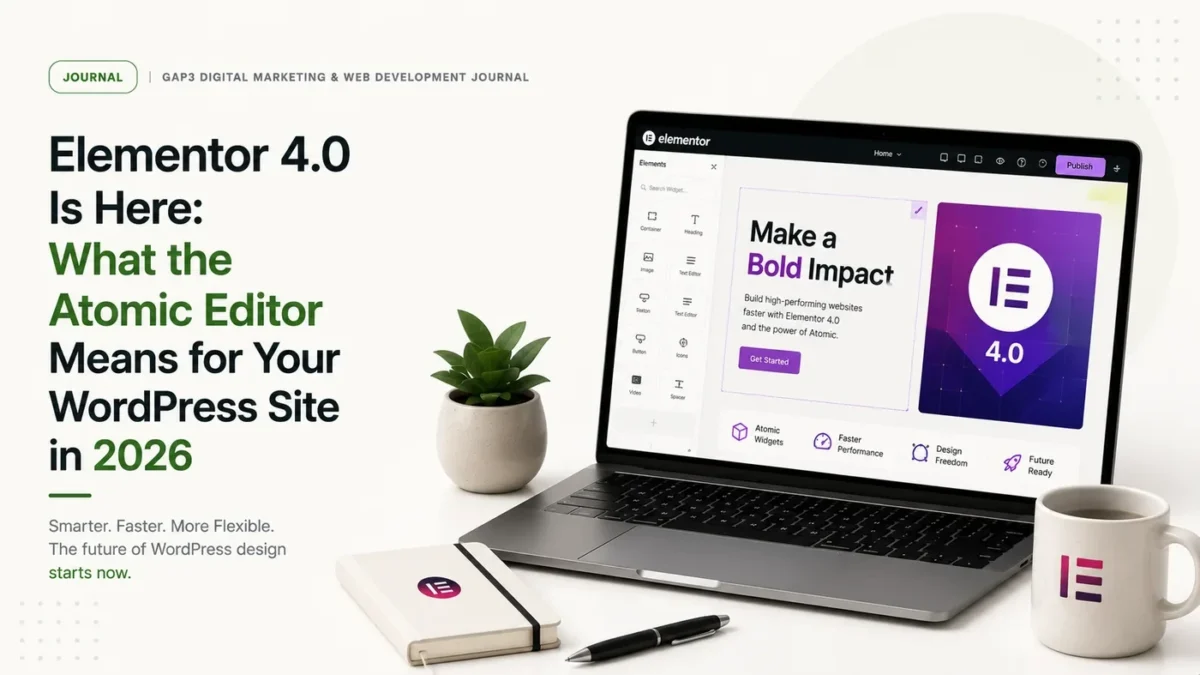
The short version
Elementor 4.0 launched in March 2026 and quietly became the most significant page builder update in five years. Atomic Editor is now the default for new sites. New installations ship with Atomic Elements, Variables, Classes, Components, and a fully redesigned Forms widget. Existing sites can opt in at their own pace, with no rebuilds and no breakage. Here is what actually changed, and what it means for the websites you already run.
The headline: V4 is no longer a beta
For nearly a year, Editor V4 lived in alpha through versions 3.29 to 3.34. It hit beta with 3.35 in February 2026. Then on March 19, 2026, Elementor 4.0 became official, and Atomic Editor flipped from an opt in experiment to the way Elementor works now.
If you have been holding off because V4 felt like a moving target, it is not anymore. Atomic is stable, production ready, and the new default for fresh installs.
What Atomic Editor actually does differently
Old Elementor was widget first. You dragged a widget, configured it, and styled it inline. Repeat across 40 pages and you have 40 places to update when the brand changes. Atomic flips that. The new architecture is built around four primitives:
- Atomic Elements. Granular building blocks such as Heading, Paragraph, Button, and Image with cleaner HTML output and zero legacy DOM bloat.
- Variables. Store colors, spacing values, and font sizes once and reuse them everywhere. Change the variable, the whole site updates.
- Classes. Define styling patterns, such as a card look or a primary button treatment, and apply them across templates. CSS style thinking inside the editor.
- Components. Convert any container into a reusable layout section that syncs across the site. Edit once, propagate everywhere.
The result is the kind of design system thinking we usually reserve for Figma or coded sites, but inside Elementor, with no rebuild required.
The features that actually matter for production sites
1. Atomic Forms (Pro)
The biggest single change for Pro users. Forms are no longer a single locked down widget. You now assemble them by placing individual Label, Input, Textarea, and Submit Button elements inside a Form container. Every part of every form is now an independent element you can style, animate, and integrate with Classes and Variables. If you have ever fought the old form widget to match a custom design, this fixes that.
2. Inline editing for Atomic Buttons
Click a button, edit the text right on the canvas. A small thing, but the kind of small thing that adds up over a hundred edits a week.
3. Components with detach
Reusable components can now be detached from their master when you need a one off variation. System consistency by default, custom flexibility on demand.
4. Variable and Class sync with V3 globals
Elementor 4.0 lets you sync Color Variables to v3 Global Colors, and Typography Classes to v3 Global Fonts. Change a variable in V4 and your legacy V3 widgets on the same site update automatically. This is the bridge that makes gradual migration realistic.
5. Import and export design systems
You can now move Variables and Classes between templates and websites. Build a brand system once, drop it onto every client project. Conflict resolution logic prevents accidental overwrites.
Should you migrate existing sites?
For new client work after April 2026, start in V4. The atomic workflow is genuinely faster once you are in it. For existing sites, do not rush. Updating to 4.0 does not change anything about your live site, because V4 features are opt in via WordPress admin, Elementor, Features. You can run V3 widgets and V4 atomic elements on the same page. Migrate when you are refactoring anyway. For complex production sites with custom plugins, test on staging first, since some third party add ons are still catching up to the V4 architecture.
What this means for your business
- Brand changes get faster. Update one variable, every page updates.
- Multi site delivery scales. Export your design system, import on the next project, ship with a consistent foundation in minutes.
- Performance gets better. Cleaner HTML output and less DOM bloat means better Core Web Vitals and better SEO.
The trade off is a learning curve. The atomic mental model is closer to a coded design system than to traditional Elementor. Worth it, but not free.
The bottom line
Elementor 4.0 is not a cosmetic update. It is the foundation Elementor will build on for the next five years. If you have ever wished WordPress page building felt more like working with a real design system, this is the release that gets you there. We have been moving client projects to Atomic incrementally over the last quarter, and the verdict so far is faster builds, cleaner sites, and fewer moments of wondering where a style lives. Need help moving your WordPress site to Elementor 4.0? We do strategy first migrations that do not break what is already working.